
Senior Software Engineer Roadmap 2026

Most software engineers land their first or second role and then stop deliberately leveling up.
You get comfortable with your tech stack, attend standups and just ship features.
But you never sit down and honestly audit what you actually know versus what you’re just winging.
That gap will follow you into every senior interview you ever walk into.
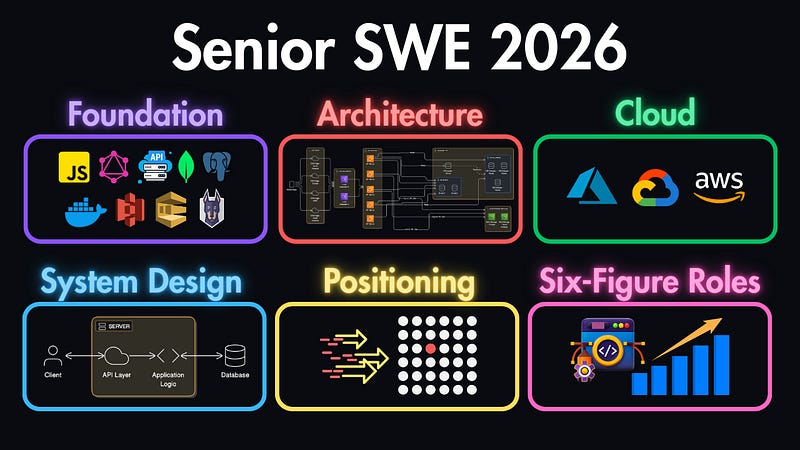
Here are the 3 pillars you need to master throughout your career to always stay employable for senior positions:
1. Your Technical Foundation Is Probably Full of Gaps
The first pillar is your technical foundation and it has five components you need to address honestly.
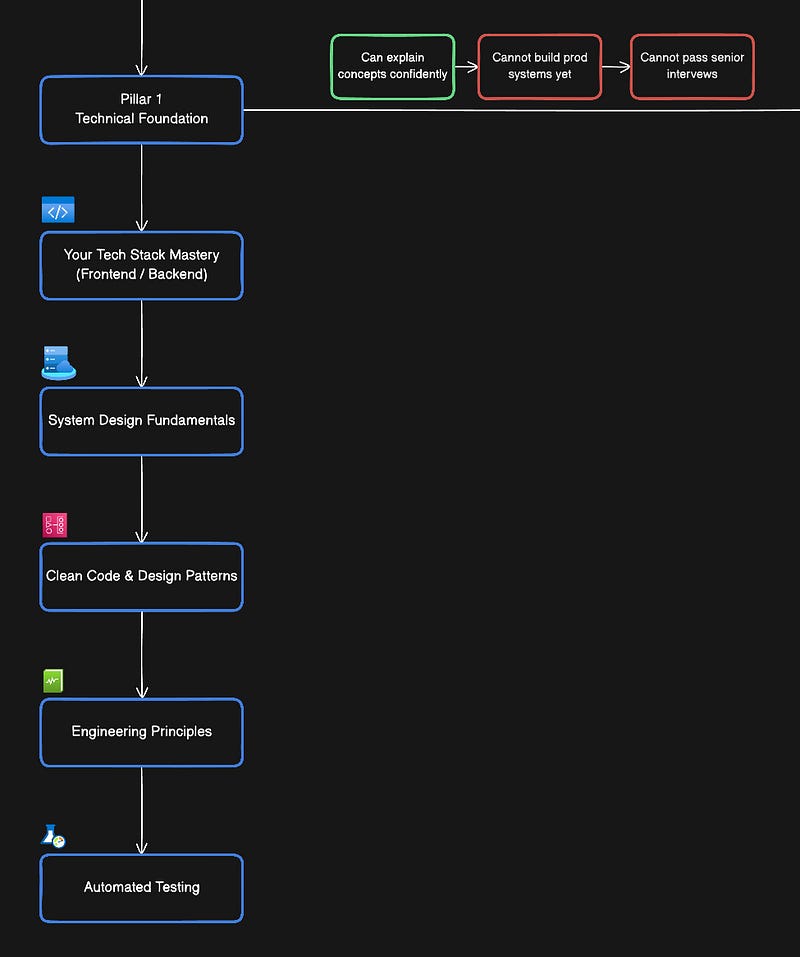
Tech Stack Depth
Whether you’re frontend, backend, or full stack, there are almost certainly areas in your stack you’ve avoided or never had to touch.
Those are exactly the areas a senior engineer is expected to own.
Identify them. Fill them.
System Design Fundamentals
Companies don’t just want developers who write code. They want developers who can think at a high level about how systems are designed and why certain decisions are made.
You don’t need to become a distributed systems expert overnight. But you need to understand how the concepts apply to the real systems you’re working on, not just theoretical diagrams.
Clean Code and Design Patterns
Here’s a trap a lot of developers fall into: spending weeks reading design pattern books filled with examples about dogs, cats, and geometric shapes.
None of that applies directly to a production codebase that already exists.
Instead, learn a handful of patterns, understand where they solve real problems, and apply them where they genuinely fit — not everywhere just to show you know them.
Engineering Principles
SOLID, DRY, KISS and more. You should be familiar with these and, more importantly, able to explain how they apply to real systems you’ve worked on.
Automated Testing
If you don’t understand the difference between unit tests, integration tests, and end-to-end tests, or if you’ve never run a performance test using a tool like k6, that’s a gap you need to close.
Load testing and knowing when and how a system breaks are skills seniors are expected to have.
After this pillar, you’ll be able to explain concepts confidently in theory.
But there’s still a problem: knowing something in theory and having built it are two very different things in an interview room.
2. You Need Real Production Architecture Experience
This is the gap that keeps most mid-level developers stuck.
You can watch every system design video on YouTube. You can read every article on load balancing and caching.
But the moment an interviewer asks you which load balancing algorithm you used, whether you chose Layer 4 or Layer 7, and what AWS service you configured it through, you’ll freeze if you’ve never actually done it.
Theory without application is just trivia.
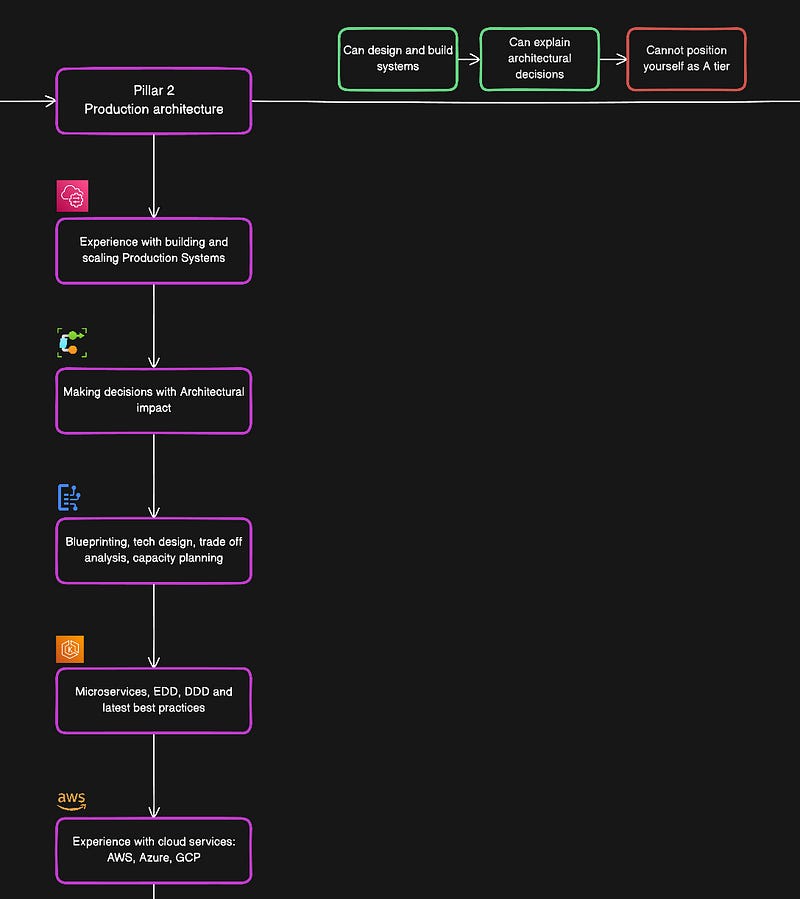
The second pillar is about getting your hands dirty with real production architecture.
Building and Scaling Real Systems
If your current job gives you exposure to production infrastructure, use it. Volunteer for the harder tickets.
Ask to be involved in architecture discussions.
If your job doesn’t offer that exposure, build something yourself. Pick a project, deploy it, scale it, and intentionally stress-test it until it breaks.
Then figure out how to fix it.
Making Architectural Decisions
Senior engineers aren’t just people who write better code. They’re people who can evaluate tradeoffs, make a defensible decision, and explain their reasoning clearly.
You need a framework for this. When you face an architectural decision, practice walking through the tradeoffs explicitly before committing to a direction.
System Design Process
You don’t start coding the moment you get requirements. Seniors blueprint first.
Learn how to go from requirements to technical design. Understand how to estimate capacity, plan for growth, and model the cost of a system before a single line of code is written.
Modern Design Practices
Most production systems you’ll encounter will be built on microservices. You need to understand event-driven design, domain-driven design (DDD), and the tradeoffs that come with each.
Cloud Experience
AWS, Azure, or Google Cloud, you need to be comfortable with at least one. If your company uses one, go deep on that one.
If not, AWS is the safest bet for job market relevance.
After completing this pillar, you can design systems from scratch and explain real architectural decisions because you’ve actually made them.
But here’s the next problem: technical mastery alone doesn’t guarantee you’ll earn what you deserve.
3. Positioning Yourself as a Top Engineer
You can master every technical skill in the world and still be underpaid.
If you can’t communicate your value clearly, companies will underpay you, not out of malice, but because you never gave them a reason not to.
The third pillar is about positioning, and it’s the one most developers skip entirely.
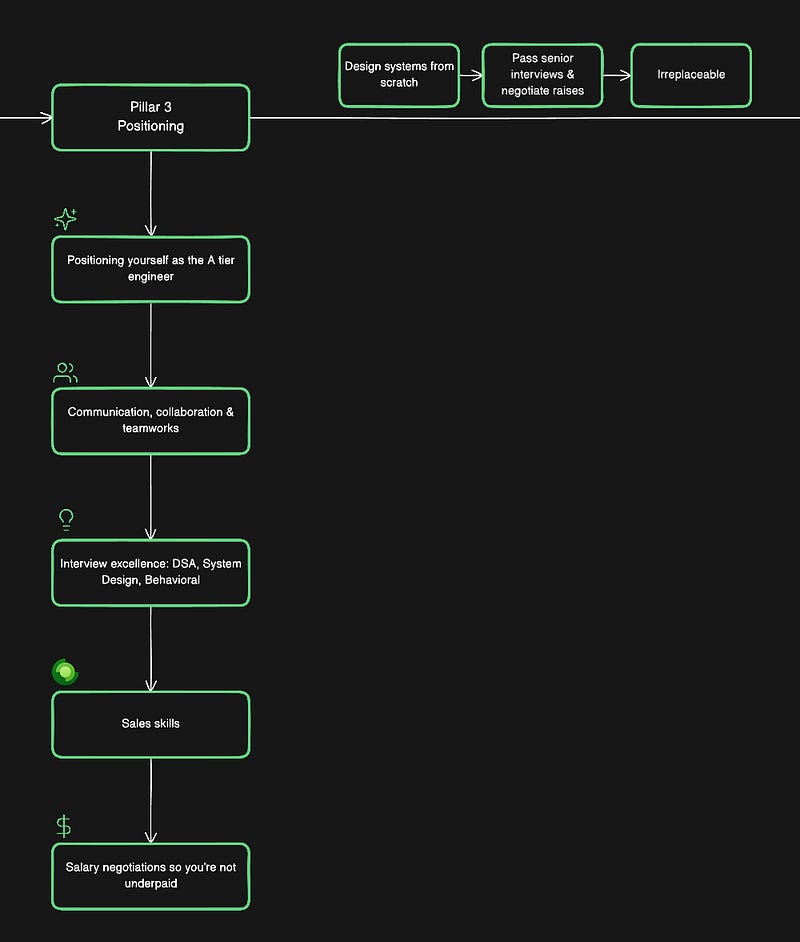
Pre-Application Presence
Before you apply anywhere, your LinkedIn profile and your resume need to tell a story about the value you bring — not just a list of technologies you’ve touched.
This is your first impression. Make it work for you before you even get on a call.
Communication and Collaboration
Senior roles aren’t won purely on technical skill. The ability to communicate clearly with teammates, stakeholders, and interviewers is part of what separates a senior from a mid-level engineer.
This is a skill you can practice and improve intentionally.
Interview Excellence
Data structures and algorithms, system design, behavioral rounds — you need to be prepared for all of them.
Even if you find DSA questions frustrating or feel they’re not representative of real work, if the companies you want to work for test them, you need to pass them. That’s just the reality of the process.
Selling Your Expertise
This isn’t about being salesy. It’s about presenting your experience in terms of business impact.
Saying you “dockerized a microservice” tells a hiring manager nothing they care about.
Explaining that you reduced deployment time by 40%, which allowed the team to ship two additional releases per quarter — that’s a different conversation entirely.
Learn to frame your work in terms of ROI, not features.
Salary Negotiation
In the majority of cases, if you know how to position yourself as an investment and not just a cost, you can increase your offer by at least 20%.
Most developers leave that money on the table simply because they don’t ask or don’t know how to ask.
Learn the skill. It compounds over your entire career.
After this pillar, you can design systems, pass interviews, negotiate your salary, and position yourself as someone companies genuinely compete to hire.
4. The Bonus Skill That Separates You From Everyone Else in 2026
Even if you master the three pillars, there is one more skill that will give you a measurable edge over other engineers in today’s job market.
AI skills.
Not in the sense of becoming a machine learning researcher. In the sense of being the engineer who knows how to integrate AI tools into real production systems and use them to work faster than anyone else on the team.
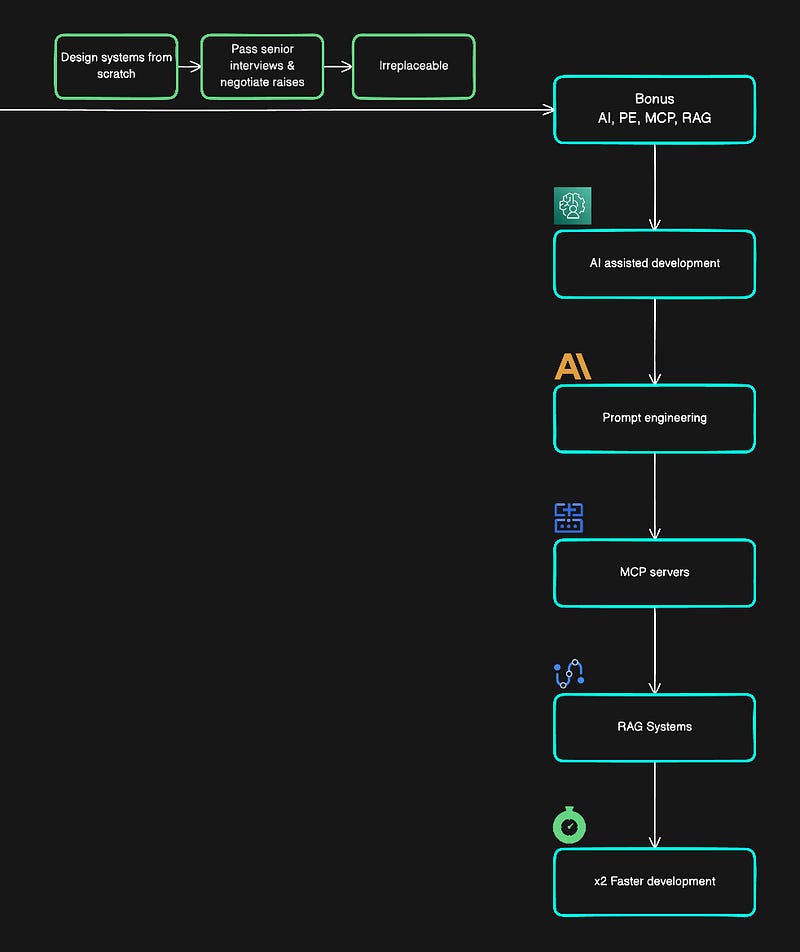
Every company, from early-stage startups to large enterprises, is actively looking for engineers who can work with this.
Here’s how to think about it across two tracks.
Track 1: AI-Assisted Development
Learn the tools that make you faster. Understand how to use AI coding assistants, how to prompt them effectively, and how to get output that is actually useful rather than just plausible-looking.
Engineers who use these tools well are measurably more productive. That has a direct impact on how you’re perceived on a team.
Track 2: Helping Companies Integrate AI
This is where it gets really valuable from a career standpoint.
Understand prompt engineering at a level where you can design reliable prompts for production use cases not just casual one-off queries.
Learn about MCP servers and how to give AI systems the right context to execute tasks reliably.
Understand RAG systems. Most AI startups and AI features inside larger products are built on retrieval-augmented generation pipelines.
Knowing how they work, what tools are involved, and how to build one puts you in a category that very few engineers are in right now.
This isn’t about chasing hype.
It’s about recognizing that this is the direction the industry has already moved and getting ahead of the engineers who are still pretending it isn’t relevant to their work.
Master all four of these areas and you won’t just be a senior engineer.
You’ll be the engineer that companies build their teams around.
Don’t Stay Stuck
You don’t need to wait 10 years to go senior.
You need the right roadmap, applied consistently over the right period of time.
The three pillars: technical foundation, real production experience, and positioning + AI skills as your edge, are everything you need to make that jump in 2026.
I’ve broken this entire roadmap down in detail in the video below, including the free downloadable version where each section is expanded with exactly what to learn and in what order.
If you’re serious about making this jump, that’s where to start 👇
Thank you for sharing
Great content! Thank you